Eliminating Assembly-Induced IMU Drift
Manufacturing Quality Improvement for Flight-Critical Drone Control Systems
Eliminating assembly-induced IMU drift in flight-critical drone electronics
Date
Overview
During drone assembly and subsequent repair operations, I identified and investigated a recurring, flight-critical failure affecting the Kite Automatic flight-test system.
Affected FCO batches showed a 30–50% first-pass failure rate, driving unnecessary PCB replacements, rework and lengthy diagnostic cycles.
Through hands-on investigation, I traced the issue to a mechanical interaction between assembly stages: installing the FlatPot power conversion module altered the clamping condition of the previously torqued FCO PCB, introducing mechanical distortion that affected IMU behaviour.
I led the corrective investigation and coordinated cross-functional validation, then introduced an updated torque sequence, a mandatory post-installation inspection, a dedicated diagnostic test and operator training. I also identified a longer-term opportunity to remove the underlying mechanical vulnerability through a revised mounting architecture.

The Problem
The Kite Automatic flight-test process showed a 30–50% first-pass failure rate on affected FCO batches, resulting in:
Frequent FCO flight-control PCB replacements
Increased repair and rework workload
Diagnostic cycles of approximately 45 minutes per unit
Failures being treated as component defects rather than assembly-related issues
Reduced confidence in flight-critical electronics
The default response was to replace the FCO, often without identifying why the failure had occurred.
Root Cause Discovery
During a routine repair, I observed that installing the FlatPot required additional tightening of FCO mounting fasteners that had already been torqued to specification.
This indicated that a subsequent assembly operation was changing the mechanical condition of the PCB after its initial torque verification.
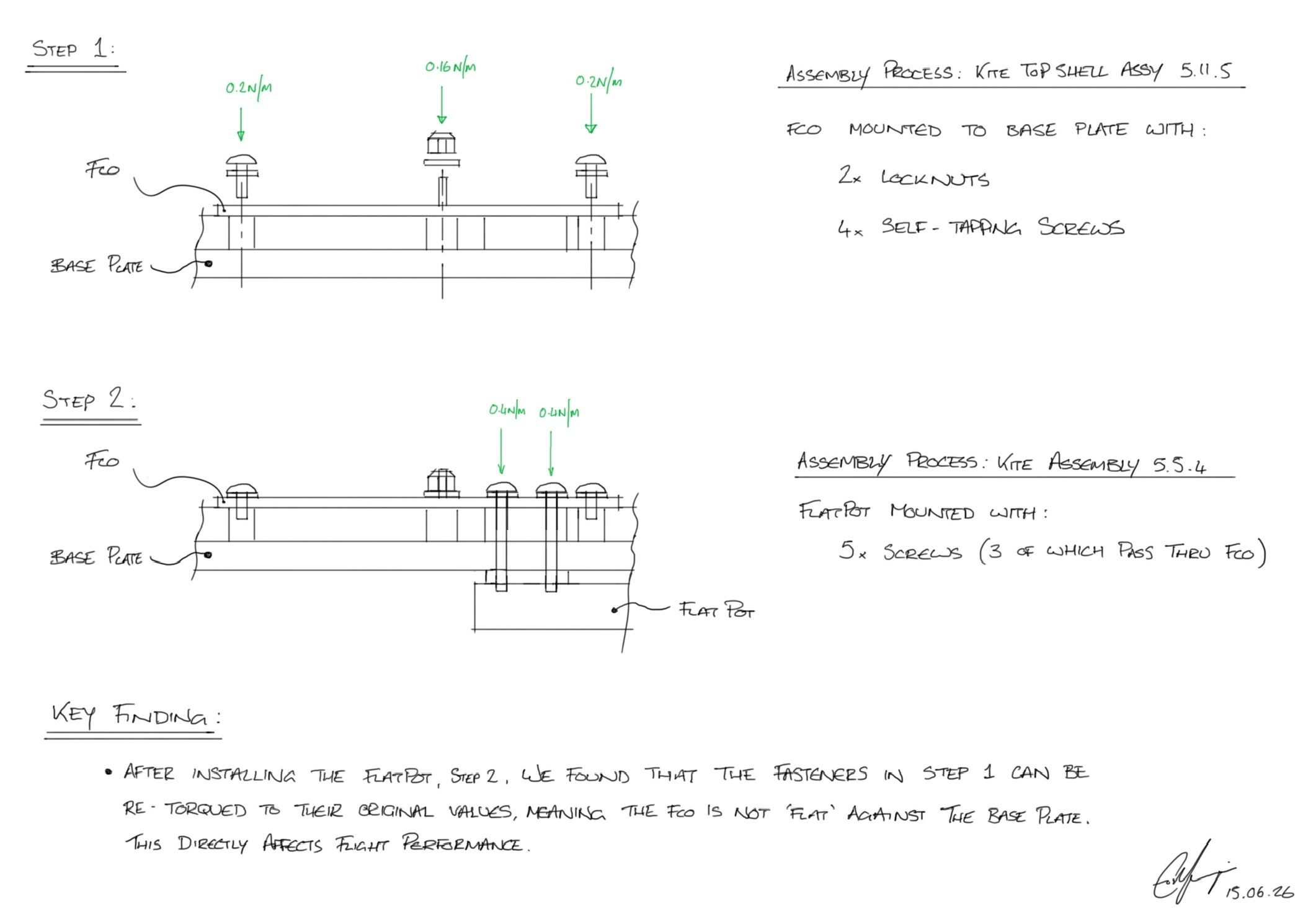
My investigation identified an interaction between the mounting arrangements:
The FCO PCB is mounted to a plastic baseplate using a combination of screws and nut/washer studs.
Installing the FlatPot introduces additional structural fasteners into the same assembly.
The resulting change in fastener loading alters the PCB's clamping condition.
This introduces mechanical distortion after the initial assembly check.
The distortion affects the mechanically sensitive IMU, resulting in inconsistent flight-test behaviour.
The key finding was that the assembly sequence could introduce a latent mechanical condition after the PCB had already passed its initial torque check.
Validation
I coordinated a cross-functional investigation with software and flight-control engineers to test the hypothesis and isolate the failure.
The investigation involved:
Extracting a dedicated five-minute FCO diagnostic test from the full 45-minute Kite Automatic test sequence
Comparing affected units before and after corrective re-torquing
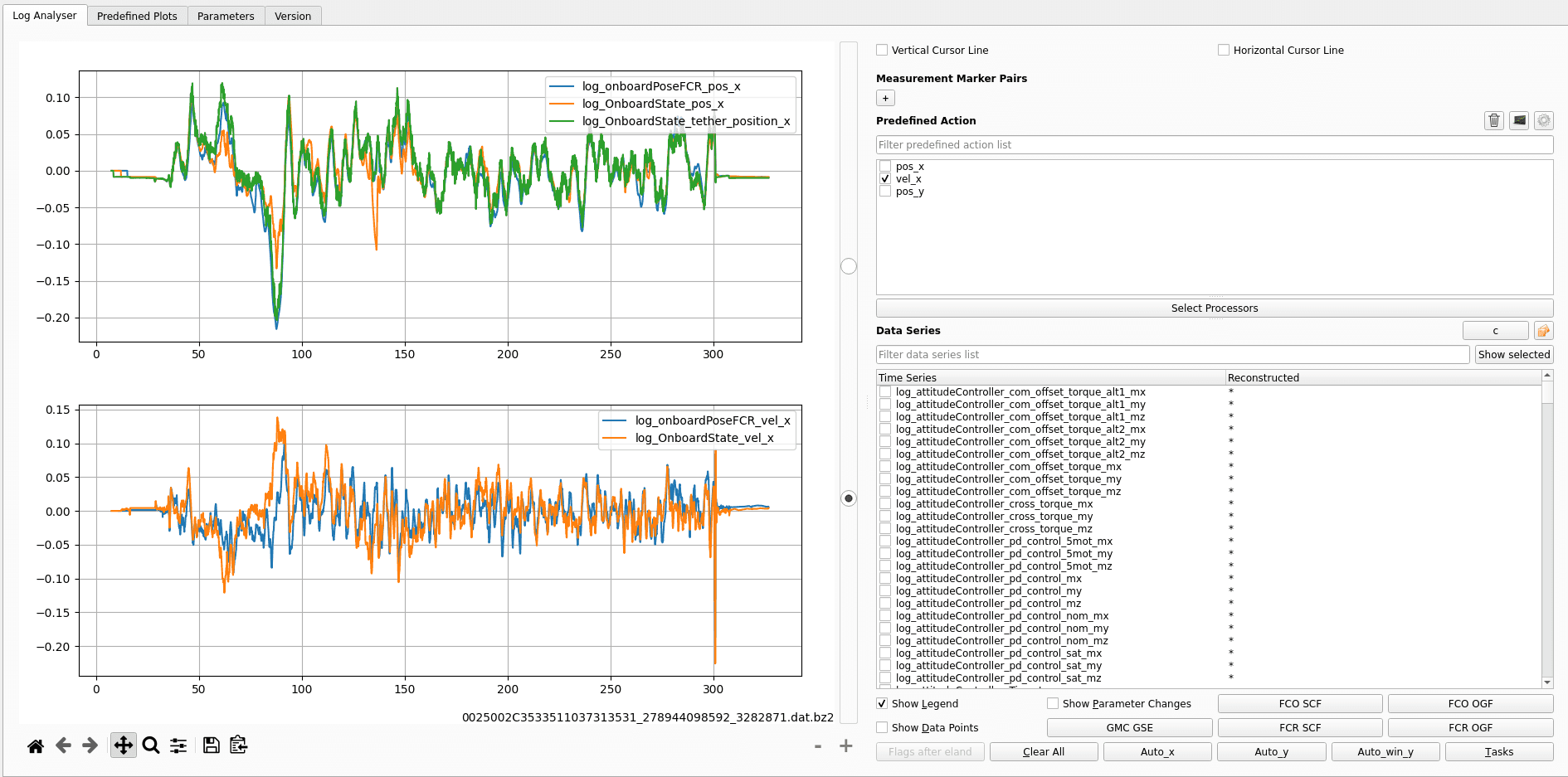
Reviewing IMU telemetry, vibration signatures and flight-stability indicators
The before-and-after comparisons showed that affected units failed prior to correction and passed after the FCO fasteners were re-torqued following FlatPot installation. Telemetry analysis also indicated improved IMU stability and reduced vibration artefacts.
These results supported the conclusion that assembly-induced mechanical distortion, rather than an inherent PCB component defect, was responsible for the observed failure behaviour.
Solution Implemented
I drove the corrective actions across assembly, diagnostics and operator training to address both the immediate failure mechanism and the way it was investigated.
1. Assembly Process Correction
Introduced a mandatory inspection and re-torque step after FlatPot installation
Updated torque sequencing instructions to maintain the intended PCB clamping condition
Clarified torque guidance for fasteners engaging with plastic threads
2. Diagnostic Acceleration
Isolated a dedicated FCO test from the full flight-test sequence
Reduced the targeted diagnostic cycle from approximately 45 minutes to five minutes
Enabled faster fault isolation without repeatedly running the complete test sequence
3. Operator Training
Delivered shop-floor training explaining the root cause and revised assembly sequence
Standardised the inspection and re-torque procedure
Reduced reliance on default FCO replacement as the first troubleshooting response
4. Cross-Functional Integration
Worked with software engineering to integrate the isolated diagnostic test into internal testing branches
Coordinated with flight-control engineers to assess IMU behaviour using telemetry
Connected repair observations with manufacturing-process improvements and engineering validation
Design Improvement (System-Level Fix)
The corrective process addressed the immediate failure mechanism, but the investigation also exposed a vulnerability in the mounting architecture: separate assembly operations could interact mechanically and introduce unintended PCB stress.
I identified a longer-term design direction to reduce dependence on assembly sequence and operator intervention:
A chassis-based PCB mounting arrangement
A slide-in, plug-in architecture inspired by motherboard interfaces
Separation of structural load paths from sensitive electronics
Controlled alignment and mounting features to minimise deformation risk
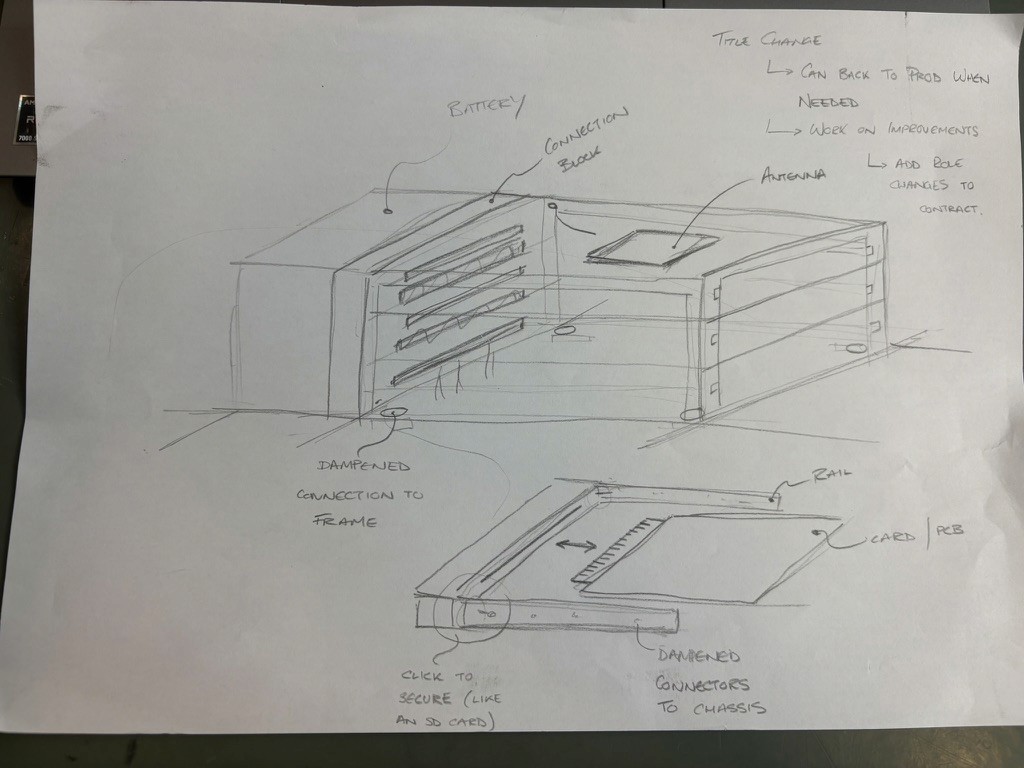
This remains a proposed design direction rather than a validated redesign. Its objective is to move from process-controlled reliability towards inherent mechanical robustness.
Impact
The investigation and corrective actions delivered several improvements:
Initial failure rate: 30–50% on affected FCO batches, establishing the scale of the original problem
Diagnostic cycle: reduced from approximately 45 minutes to five minutes for targeted FCO investigation
Fault isolation: demonstrated that corrective re-torquing could restore passing test behaviour on affected units
Assembly quality: introduced a mandatory inspection and re-torque step following FlatPot installation
Troubleshooting: shifted the response away from default component replacement towards root-cause investigation
Early rollout indicated a target of approximately 80% first-pass yield on affected builds. This should be treated as a target or preliminary estimate until supported by sufficient post-change production data.
Key Takeaway
A recurring flight-control test failure initially treated as an electronics defect was traced to a mechanical interaction between assembly stages.
By combining hands-on repair insight with mechanical reasoning and cross-functional validation, I identified the failure mechanism, implemented corrective process and diagnostic improvements, and established a direction for a more robust mounting architecture.
The project demonstrated how mechanical design, assembly sequence and verification methods directly influence the reliability of an integrated mechatronic system.